Habit Stacking: Simple Examples That Stick
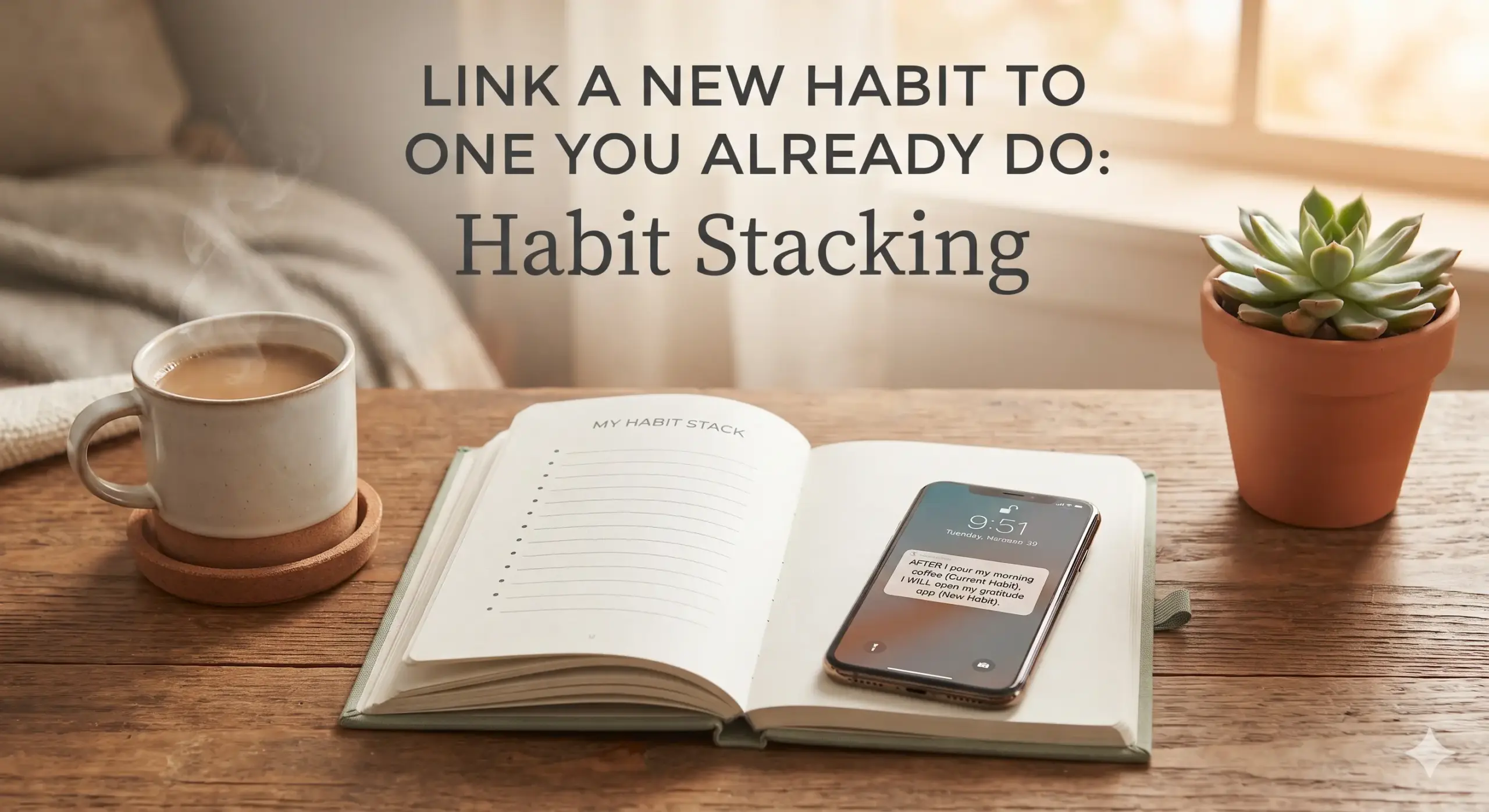
Habit stacking means attaching a new habit to something you already do every day: “After I pour my morning coffee, I’ll drink a glass of water.” Your existing routine becomes the reminder. Here’s why it works, how to build your own and 30 examples to borrow.
Key takeaways
- The formula is simple: “After I [current habit], I will [new habit].”
- It works because habits are triggered by cues, and a daily routine is a reliable cue.
- Research on “if-then” plans found a medium-to-large effect on reaching goals.
- Keep the new habit tiny, and add one link at a time.
What is habit stacking?
Habit stacking is a way of starting a new habit by linking it to an existing one. The existing habit is called the anchor. Every time you do the anchor, you do the new habit straight after it.
The name was made popular by self-help books such as Atomic Habits, but the idea behind it comes from habit research. Psychologists call these “if-then” plans implementation intentions: you decide in advance exactly when and where you’ll act.
Once a new habit is established, it can become the anchor for the next one, so a short chain, or “stack,” builds up over time:
After I switch off my alarm, I’ll drink a glass of water.
After I drink my water, I’ll stretch for two minutes.
After I stretch, I’ll write my top three tasks for the day.
Why it works
- Habits run on cues. In psychology, a habit is an action triggered automatically by a situation you’ve repeatedly done it in. Researchers at UCL describe a cue within an existing routine as “a convenient and stable starting point” for a new habit (Gardner, Lally and Wardle, 2012). Their own example: “after I have lunch at home I will have a piece of fruit.”
- If-then plans work. A review of 94 studies found that planning exactly when and where you’ll act had a medium-to-large positive effect on reaching goals (Gollwitzer and Sheeran, 2006).
- No extra reminders needed. You already do the anchor every day, so it reminds you without alarms or notes.
- It removes decisions. You don’t have to decide when to do the habit. It’s already decided.
How to build a habit stack in 5 steps
1. List your daily anchors
Write down things you already do every day without fail: waking up, brushing your teeth, making coffee, lunch, getting home, dinner, going to bed. See the list of good anchors below.
2. Choose one small new habit
Pick something that takes two minutes or less to start, such as one glass of water, one page of reading or five squats. You can make it bigger once it’s automatic. Need ideas? See our list of 50 healthy habits.
3. Match the habit to the right anchor
The anchor should happen at the right time and place for the new habit, and as often. Stretching fits after getting up; flossing fits after brushing your teeth; laying out tomorrow’s clothes fits before bed.
4. Write the sentence
Write it in full: “After I [anchor], I will [new habit].” Be specific. “After I sit down at my desk, I’ll drink a glass of water” is better than “I’ll drink more water at work.”
5. Repeat it, and track it
Do it every day in the same way, and tick it off. It takes time: in a UCL study, new habits took an average of 66 days to feel automatic. When it does, add the next link.
Track your new habit stack, free. Our Habit Tracker lets you tick off up to five habits a day and shows your streaks. No sign-up.
Open the Habit Tracker →Good anchors to stack on
The best anchors happen every day, at a fixed point, and are very specific:
| Time of day | Reliable anchors |
|---|---|
| Morning | Switching off the alarm, getting out of bed, using the toilet, brushing your teeth, making coffee or tea, eating breakfast |
| Daytime | Sitting down at your desk, starting the computer, lunch, finishing a meeting, a phone call |
| Evening | Getting home, taking off your shoes, cooking dinner, finishing dinner, washing up |
| Bedtime | Brushing your teeth, plugging in your phone, getting into bed, turning off the light |
30 habit stacking examples
Morning
- After I switch off my alarm, I’ll drink a glass of water.
- After I get out of bed, I’ll open the curtains to let in daylight.
- After I make my bed, I’ll stretch for two minutes.
- After I brush my teeth, I’ll floss one tooth (and then the rest, if I feel like it).
- After I pour my coffee, I’ll write my top three tasks for the day.
- After I eat breakfast, I’ll take my lunch out of the fridge.
- After I lock the front door, I’ll walk the long way to the bus or car.
Daytime
- After I sit down at my desk, I’ll fill my water bottle.
- After I finish a meeting or call, I’ll stand up and stretch.
- After I finish lunch, I’ll take a 10-minute walk.
- After I eat lunch, I’ll message a friend or family member.
- After I make a hot drink at work, I’ll do 10 squats or calf raises.
- After I close my laptop for the day, I’ll write tomorrow’s first task.
Evening
- After I take off my shoes, I’ll change into comfortable clothes and go for a short walk.
- After I start cooking dinner, I’ll put a vegetable on the chopping board first.
- After I sit down to eat, I’ll put my phone in another room.
- After I finish dinner, I’ll wash up straight away.
- After I wash up, I’ll prepare tomorrow’s lunch.
- After I sit on the sofa, I’ll stretch for five minutes before switching on the TV.
- After I finish one TV episode, I’ll decide whether to watch another, instead of letting it autoplay.
Bedtime
- After my wind-down alarm goes off, I’ll plug my phone in outside the bedroom.
- After I plug in my phone, I’ll lay out tomorrow’s clothes.
- After I brush my teeth, I’ll write three things I’m grateful for.
- After I get into bed, I’ll read a few pages of a paper book.
- After I turn off the light, I’ll take five slow breaths.
Weekly
- After Sunday breakfast, I’ll plan the week’s dinners.
- After I plan dinners, I’ll write the grocery list.
- After I put the shopping away, I’ll wash and chop vegetables for the week.
- After my Sunday evening meal, I’ll do a 10-minute weekly check-in.
- After I pay a monthly bill, I’ll book something to look forward to.
Plan your cues on paper. $9 The printable 90-Day Healthy Habits Planner has space to write each habit’s cue and backup plan, with monthly trackers and weekly reviews.
See the 90-Day Healthy Habits Planner →Common mistakes
- A vague anchor. “In the morning” isn’t a cue. “After I pour my coffee” is.
- An anchor that doesn’t happen every day. If you only go to the gym twice a week, it’s not a reliable anchor for a daily habit.
- A new habit that’s too big. “After breakfast, I’ll run 5km” is hard to keep. “After breakfast, I’ll put on my trainers” is easy, and often leads to more.
- Stacking too much too soon. Add one new link at a time, and only once the last one feels automatic.
- The wrong place. If your new habit needs equipment, such as a water bottle or a book, keep it where the anchor happens.
- Giving up after a missed day. UCL research found that missing one day didn’t significantly affect habit forming. Just do it next time.
Common questions
What is habit stacking?
Habit stacking means linking a new habit to something you already do every day, using the formula “After I [current habit], I will [new habit].” The existing habit acts as a reminder for the new one.
Does habit stacking really work?
It’s based on well-studied ideas. Habits are triggered by cues, and a review of 94 studies found that “if-then” plans, which say exactly when and where you’ll act, had a medium-to-large positive effect on reaching goals.
How many habits can I stack?
Start with one new habit on one anchor. Once it feels automatic, add another link. A stack of three or four small habits is plenty for most routines.
What if I forget the new habit?
Make the cue more visible. Put a note or the equipment you need right where the anchor happens, such as a water glass next to the kettle. If you still forget, try a different anchor.
Sources
- Gardner, Lally and Wardle (2012): Making health habitual. British Journal of General Practice, 62(605), 664–666
- Gollwitzer and Sheeran (2006): Implementation intentions and goal achievement, a meta-analysis of effects and processes. Advances in Experimental Social Psychology, 38, 69–119
- UCL News: How long does it take to form a habit?
Related tools and guides
This guide is for general education and is not medical advice. See our Health Disclaimer and Editorial Policy.