How to Build a Simple Daily Wellness Routine
A good daily routine isn’t a long list of rules. It’s a few small, healthy habits placed at the same points in your day (when you wake up, around meals and before bed) so you do them without having to think about it.

Key takeaways
- Anchor your day with a steady wake-up time and bedtime. Most adults need at least 7 hours of sleep.
- Build around five basics: sleep, water, movement, balanced meals and a short wind-down.
- Start with three small steps, not ten. Add more once they feel automatic.
- Expect it to take around two months or more for a routine to feel natural, and don’t worry about the odd missed day.
Why a routine helps
Every day is full of small decisions: when to get up, whether to go for a walk, what to eat, when to put the phone down. A routine takes some of those decisions off your plate. Instead of debating each one, you simply do “what you do after waking up” or “what you do before bed.”
Routines also make good habits easier to build. A 2024 review of 20 studies on health habits found that habits done in a consistent setting and at a consistent time became automatic more reliably, and that habits people chose for themselves stuck better than ones they were told to do (Singh et al., Healthcare, 2024). A daily routine gives every habit that consistent time and place.
The five basics to build around
You don’t need a complicated plan. Most of what makes a day feel healthier comes down to five things.
1. A steady sleep schedule
Your wake-up time is the anchor for everything else. The CDC recommends at least 7 hours of sleep for adults aged 18 to 60, and advises going to bed and getting up at the same time every day, including weekends. Getting some natural light soon after you wake up can also help keep your body clock in sync, according to the Sleep Foundation.
2. Enough water
The NHS suggests aiming for 6 to 8 cups or glasses of fluid a day, and says water, lower-fat milk and lower-sugar drinks, including tea and coffee, all count. The easiest way to fit this into a routine is to tie a glass to things you already do: waking up, each meal, and arriving at work.
3. Some movement every day
The CDC recommends that adults get at least 150 minutes of moderate activity a week, such as brisk walking. That’s 30 minutes a day, five days a week, and it can be split into shorter chunks. The NHS notes that even a brisk 10-minute daily walk counts toward that total.
4. Balanced meals at regular times
A simple guide for any meal is Harvard’s Healthy Eating Plate: make half your plate vegetables and fruit, a quarter whole grains and a quarter healthy protein. Eating at roughly the same times each day also gives your routine natural checkpoints for a glass of water or a short walk.
5. A wind-down before bed
The last part of the day sets up the next morning. The CDC suggests turning off electronic devices at least 30 minutes before bed and avoiding large meals and alcohol close to bedtime. A short, repeatable wind-down tells your body the day is ending.
Build your routine in two minutes. Our free Daily Routine Planner turns your wake-up time and bedtime into a printable morning and evening schedule.
Open the Daily Routine Planner →A sample daily wellness routine
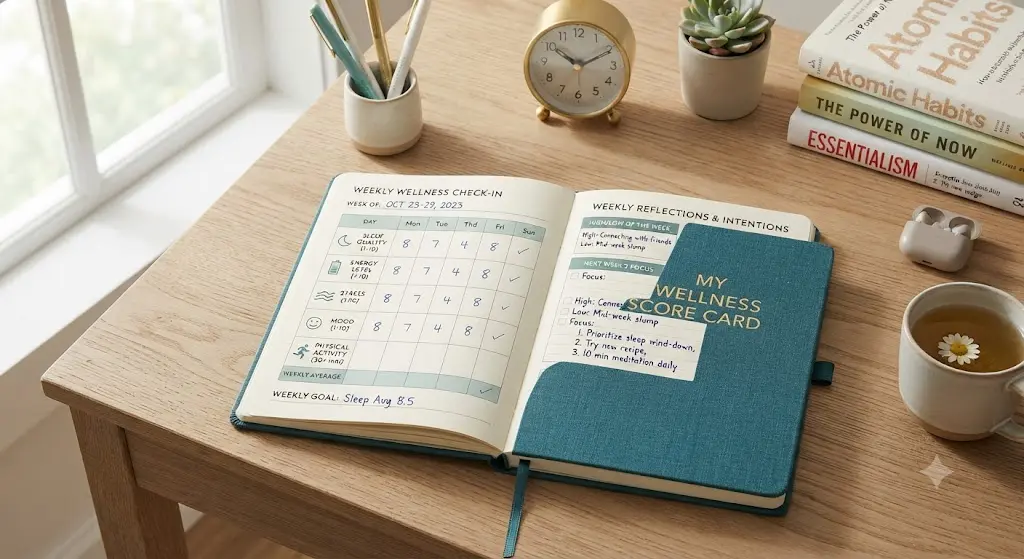
Here’s what a simple routine might look like for someone who wakes at 6:30 a.m. and sleeps at 10:45 p.m. Treat it as a starting point and change the times and steps to suit your day.
| Time | Step | Why it helps |
|---|---|---|
| 6:30 a.m. | Wake up at the same time; drink a glass of water | Anchors your body clock; starts your fluids early |
| 6:35 a.m. | Open the curtains or step outside; stretch for 5–10 minutes | Morning light and gentle movement help you wake up |
| 7:00 a.m. | Breakfast with fruit or vegetables | A head start on balanced eating |
| Midday | Lunch away from your desk, plus a 10-minute walk | Movement in small chunks counts |
| Afternoon | Refill your water bottle; switch to non-caffeinated drinks | Late caffeine can make it harder to fall asleep |
| 7:30 p.m. | Dinner, then a short walk | An easy way to add activity |
| 9:45 p.m. | Tidy up and prepare for tomorrow | Makes the next morning easier |
| 10:15 p.m. | Screens off; read, stretch or relax | Helps your mind slow down before sleep |
| 10:45 p.m. | Lights out | Allows 7¾ hours before the 6:30 alarm |
Notice that most steps take five to fifteen minutes. A routine that fits a busy day is far more useful than a perfect one you can only manage on weekends.
How to start (and keep going)
Pick three steps, not ten
Choose one step for the morning, one for midday and one for the evening. For example: water after waking, a walk after lunch, and screens off 30 minutes before bed. Once these feel easy, add one more.
Attach each step to something you already do
New habits stick better when they follow a clear cue. Use a simple “after… I will…” plan: after I brush my teeth, I will drink a glass of water; after I finish lunch, I will walk for 10 minutes. The cue does the remembering for you.
Make it easy to do
- Leave a glass or water bottle by the sink or on your desk.
- Put your walking shoes by the door.
- Charge your phone outside the bedroom so screens-off happens naturally.
- Plan the week’s meals in one go with the free Meal Planner.
Keep weekends close to weekdays
The most important part to keep is your wake-up time. If you want to change it, the Sleep Foundation suggests shifting it gradually, by 15 or 30 minutes at a time over several days, rather than all at once. Our Sleep Planner can help you pick a time that fits your sleep cycles.
Expect it to take a while
The popular idea that habits take 21 days isn’t backed by the research. In a well-known study from University College London, a new daily habit took an average of 66 days to feel automatic. The 2024 review found most health habits take somewhere around two to five months, with big differences between people. So be patient with yourself.
Don’t let one missed day stop you
The UCL researchers found that missing a single day did not significantly affect habit formation. What matters is getting back to it the next day. Tracking your routine in the free Habit Tracker makes it easy to see your streaks and pick up where you left off.
Common questions
What is a daily wellness routine?
It’s a set of small, healthy habits you do at roughly the same points each day, such as drinking water when you wake up, walking after lunch and switching off screens before bed. The aim is to make healthy choices automatic rather than something you have to remember.
How many habits should I start with?
Three is a good number: one each for the morning, the middle of the day and the evening. Simple habits become automatic sooner, and you can add more once the first ones feel easy.
What if my schedule changes every day?
Tie your habits to events rather than clock times, such as “after waking,” “after lunch” or “before bed.” Try to keep your wake-up time steady, since it anchors the rest of the day.
How long does it take for a routine to feel natural?
Usually longer than three weeks. Research suggests an average of around 66 days for a single daily habit, and two to five months for many health habits, with wide differences between people.
A note on your health: this guide covers general everyday habits for healthy adults. If you have a medical condition, take medication, are pregnant, or have trouble sleeping that doesn’t improve, talk to a doctor before making big changes to your routine.
Sources
- CDC: About Sleep
- CDC: Physical activity guidelines for adults
- Sleep Foundation: How to reset your sleep routine
- NHS: Water, drinks and your health
- NHS: Walking for health
- Harvard T.H. Chan School of Public Health: Healthy Eating Plate
- UCL News: How long does it take to form a habit?
- Singh et al. (2024): Time to form a habit, a systematic review and meta-analysis
Related tools
This guide is for general education and is not medical advice. See our Health Disclaimer and Editorial Policy.