How to Track Habits Without Giving Up

Habit tracking is simple: tick a box each day you do the thing. It works because it makes progress visible. But most people quit within a few weeks, usually because they track too much or give up after a missed day. Here’s how to track in a way that lasts.
Key takeaways
- Track no more than three to five habits at a time.
- Make each habit specific, so it’s clear whether you did it.
- Tick it immediately, at the same moment each day.
- A missed day isn’t failure. Research shows one miss doesn’t undo progress; try not to miss twice in a row.
Why tracking helps
- It’s a daily reminder. Seeing the tracker prompts you to do the habit.
- It shows progress. A row of ticks is satisfying, and it builds momentum.
- It shows patterns. You’ll quickly see which days you usually skip, and can plan around them.
- It keeps you honest. It’s easy to think “I walk most days.” A tracker shows whether you really do.
Tracking matters most in the early weeks, before a habit feels automatic. In a well-known UCL study, new daily habits took an average of 66 days to become automatic, and a 2024 review suggests two to five months is realistic for most health habits. A tracker helps carry you through that stretch.
Why people stop tracking
| Problem | Fix |
|---|---|
| Tracking ten habits at once | Track three to five. Add more later. |
| Vague habits (“eat better”) | Make them yes-or-no (“vegetables at dinner”). |
| Forgetting to tick | Tick at a fixed moment, such as after dinner or before bed. |
| Giving up after a broken streak | Focus on your weekly total, not just the streak. |
| Too much effort to update | Use something that takes seconds: a printed sheet or a simple tracker. |
How to track habits that last: 7 rules
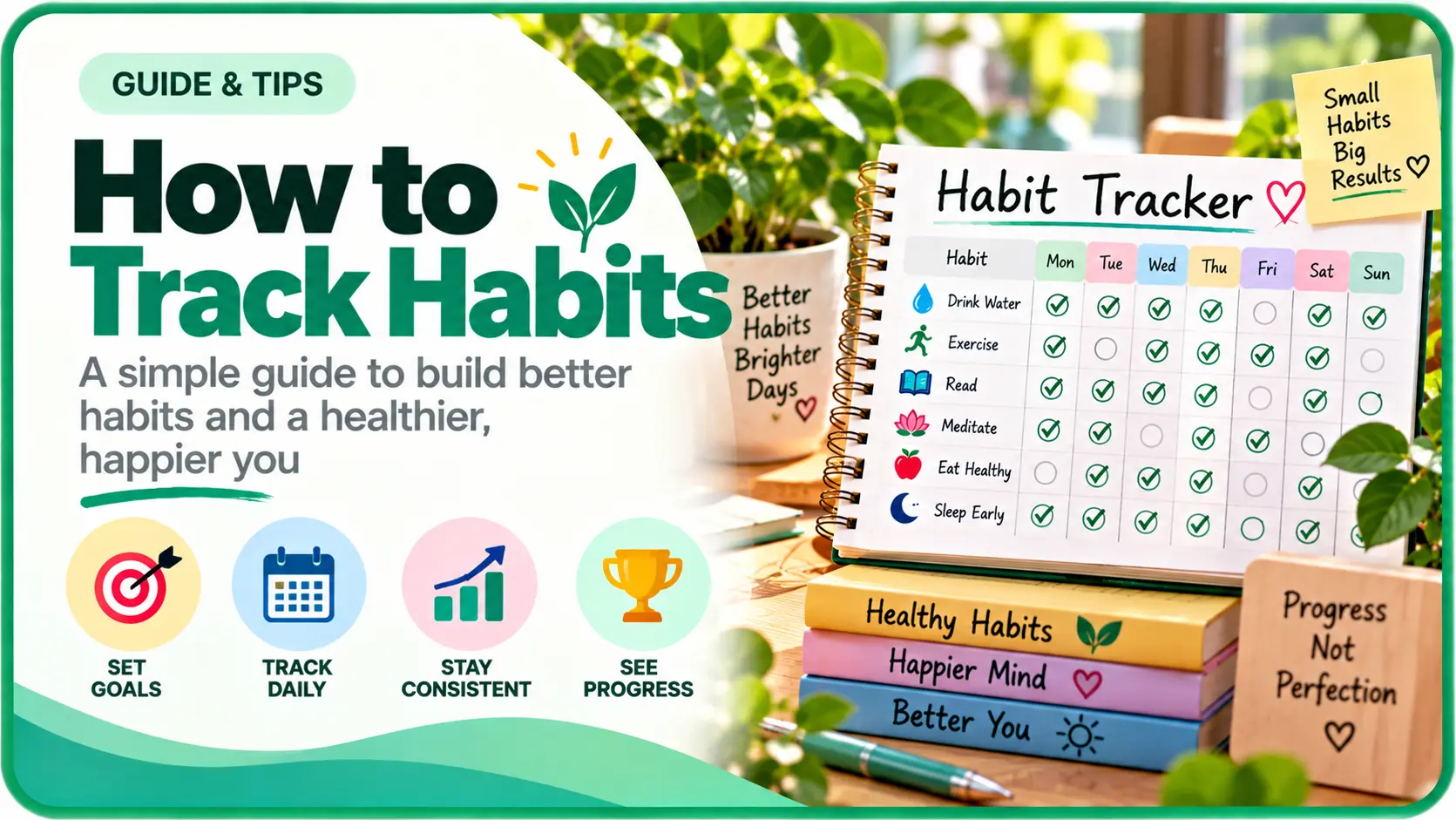
1. Start with three habits
Three is enough to feel useful and few enough to keep up. If you already have a good habit or two, include one; easy ticks keep you motivated.
2. Make every habit a clear yes or no
You should know instantly whether to tick it. “Exercise more” is hard to judge; “walk for 10 minutes” isn’t. Write the minimum version: the smallest amount that counts.
3. Link each habit to a cue
Attach each habit to something you already do: “after I wake up, I drink a glass of water.” The 2024 review found that doing habits in a consistent setting made them stronger.
4. Tick it straight away
Mark the habit as soon as you’ve done it, or at one fixed check-in time each evening. Leaving it until the end of the week means forgotten ticks and a tracker you don’t trust.
5. Keep the tracker visible
Stick a paper tracker on the fridge, or bookmark your tracker on your phone’s home screen. Out of sight really does mean out of mind.
Free habit tracker, no sign-up. Track up to five habits on a weekly grid with streaks and a weekly score. It saves on your device and prints on one page.
Open the Habit Tracker →6. Never miss twice
You will miss days. The UCL researchers found that missing one opportunity did not significantly affect habit formation, but people who were often inconsistent didn’t form the habit. So the rule is simple: if you miss one day, make the next day a priority, even if you only do the smallest version.
7. Judge the week, not the day
Streaks are motivating, but one broken streak can make people give up entirely. Look at your weekly completion instead. Five out of seven days is a good week, and far better than zero.
What to track: examples by goal
Good habits to track are small, daily and clearly yes-or-no. A few examples:
| Goal | Habit to track | Tick when… |
|---|---|---|
| Sleep better | Screens off 30 minutes before bed | You put the phone away on time |
| Drink more water | Glass of water with each meal | You had water at all three meals |
| Move more | 10-minute walk | You walked for at least 10 minutes |
| Eat better | Vegetables at dinner | Dinner included a vegetable |
| Feel calmer | 5 minutes of quiet or slow breathing | You took the 5 minutes |
| Stay connected | Message or call someone | You reached out to one person |
Avoid tracking outcomes you can’t control day to day, such as your weight or mood. Track the actions instead; those are what build the habit.
Paper or app?
Either works; pick the one you’ll actually use.
- Paper: visible on the fridge or desk, satisfying to tick, no phone needed. Our Habit Tracker prints a clean weekly sheet.
- Online: always with you, calculates streaks and percentages automatically, and lets you look back at past weeks.
Some people use both: online for the record, and a printed copy on the fridge as a reminder.
How to review your tracker
Once a week, spend two minutes looking at your tracker and asking:
- What went well? Which habits are nearly automatic?
- Where did I miss? Same day each week? Same reason?
- What would make next week easier? A better cue, a smaller version, or better preparation?
- Is a habit ready to “graduate”? If you’ve done it nearly every day for a couple of months and it feels automatic, you can stop tracking it and add something new.
For a broader look at sleep, water, movement and more, try our weekly wellness check-in.
Common questions
How many habits should I track at once?
Three to five. Fewer habits are easier to keep up, and you can add more once the first ones feel automatic.
What should I do when I miss a day?
Just get back to it the next day. Research from UCL found that missing one day did not significantly affect habit formation. Try not to miss two days in a row.
How long should I track a habit?
Until it feels automatic, which often takes around two months or more. After that, you can stop tracking it and focus on a new habit.
Is a paper or digital habit tracker better?
Whichever you’ll use consistently. Paper is visible and simple; digital trackers calculate streaks and history automatically. Many people use both.
Sources
- UCL News: How long does it take to form a habit?
- Singh et al. (2024): Time to Form a Habit, a systematic review and meta-analysis. Healthcare, 12(23), 2488
Related tools and guides
This guide is for general education and is not medical advice. See our Health Disclaimer and Editorial Policy.