30-Day Self-Care Challenge: One Small Idea a Day
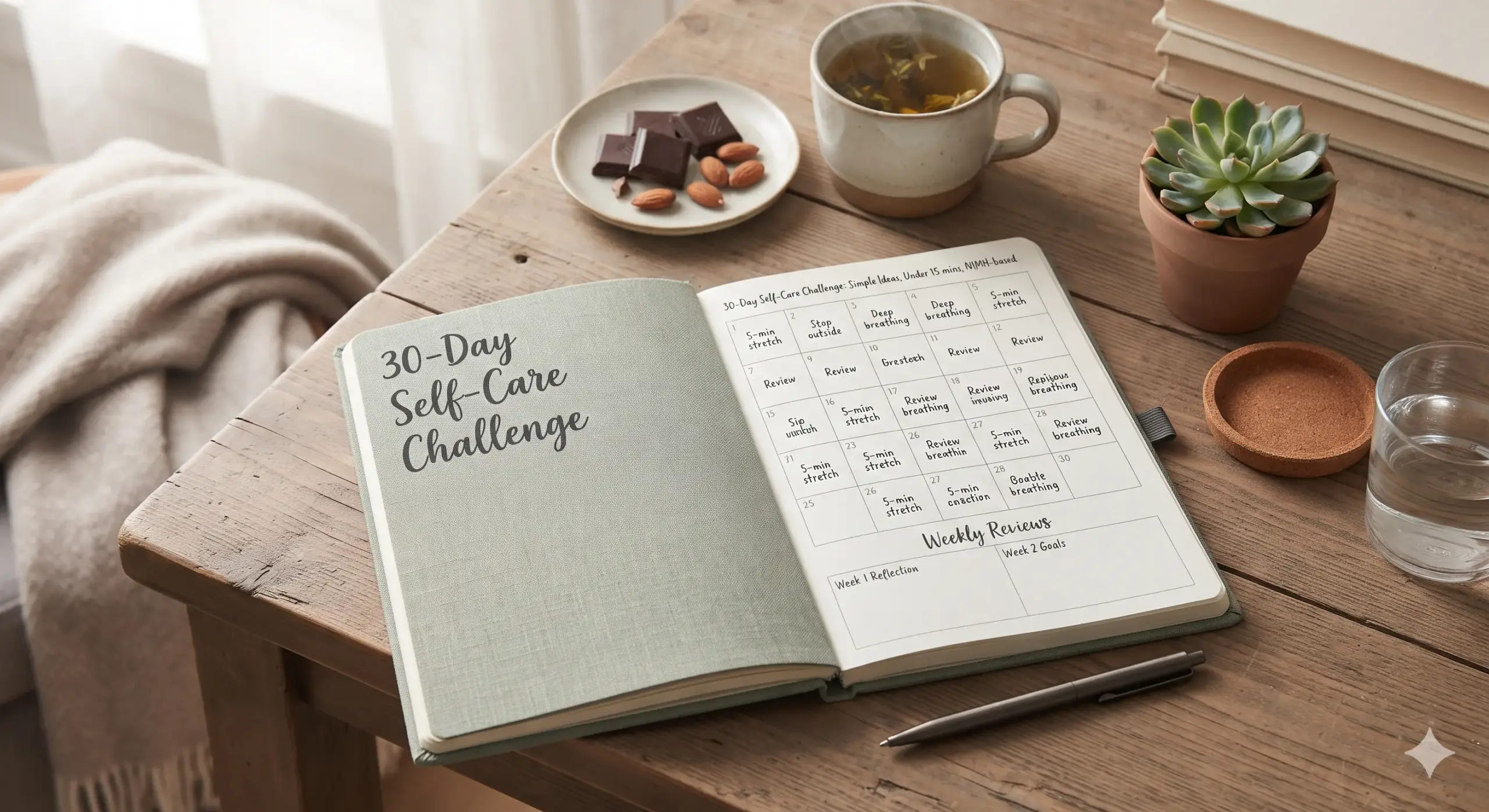
Self-care doesn’t have to mean spa days or expensive treats. It’s mostly small, ordinary things done regularly: a short walk, an earlier night, a message to a friend. This 30-day challenge gives you one simple idea each day, most taking 15 minutes or less.
Key takeaways
- Do one small self-care action a day for 30 days. Most take 5 to 15 minutes.
- The ideas follow the basics the U.S. National Institute of Mental Health suggests: move, eat and drink well, sleep, relax, set priorities, practice gratitude and stay connected.
- Each week ends with a short review, so you can see what helps you most.
- Missing a day doesn’t matter. Pick up where you left off.
How the challenge works
Each day has one small action. Do it whenever suits you, then tick it off. The four weeks build gently:
- Week 1 covers everyday basics: water, walking, sleep and gratitude.
- Week 2 focuses on rest and calm.
- Week 3 adds a little more movement and better food.
- Week 4 looks after your mind and your relationships.
The ideas are based on the self-care tips from the National Institute of Mental Health (NIMH). NIMH describes self-care as taking time to do things that help you live well and improve your physical and mental health. It also notes that small acts of self-care in daily life can have a big impact.
Free Self-Care Planner, no sign-up. Pick your self-care ideas for the week, tick them off each day and print your plan on one page.
Open the Self-Care Planner →Week 1: The basics
| Day | Today’s self-care | Time |
|---|---|---|
| 1 | Drink a glass of water as soon as you get up. | 1 min |
| 2 | Take a 10-minute walk, outside if you can. | 10 min |
| 3 | Choose a bedtime and put your phone away 30 minutes before it. | 5 min |
| 4 | Write down three specific things you’re grateful for today. | 5 min |
| 5 | Eat one meal sitting down, without a screen. | 15 min |
| 6 | Message a friend or family member just to say hello. | 5 min |
| 7 | Week review: which day felt best, and why? | 5 min |
Week 2: Rest and calm
| Day | Today’s self-care | Time |
|---|---|---|
| 8 | Sit quietly and breathe slowly for five minutes. | 5 min |
| 9 | Tidy one small space: a drawer, your desk or your bedside table. | 10 min |
| 10 | Go to bed 20 minutes earlier than usual. | 20 min |
| 11 | Spend 15 minutes outdoors: a park, a garden or just your doorstep. | 15 min |
| 12 | Say no to one thing you don’t really have time for. | 2 min |
| 13 | Listen to music you love, and do nothing else. | 15 min |
| 14 | Week review: what helped you feel calmer? | 5 min |
Week 3: Body and energy
| Day | Today’s self-care | Time |
|---|---|---|
| 15 | Walk for 20 minutes at a pace that makes you breathe a little faster. | 20 min |
| 16 | Add a vegetable to both lunch and dinner. | 5 min |
| 17 | Stretch gently for 10 minutes. | 10 min |
| 18 | Swap one sugary drink for water. | 1 min |
| 19 | Cook a simple meal at home. | 30 min |
| 20 | Try a different kind of movement: dancing, cycling, swimming or yoga. | 20 min |
| 21 | Week review: when did you have the most energy? | 5 min |
Week 4: Mind and connection
| Day | Today’s self-care | Time |
|---|---|---|
| 22 | Notice one unhelpful thought and rewrite it the way you’d speak to a friend. | 5 min |
| 23 | Call (don’t text) someone you care about. | 15 min |
| 24 | Do something creative: draw, write, cook, build or play music. | 15 min |
| 25 | Read for 20 minutes instead of scrolling. | 20 min |
| 26 | Plan a small treat for yourself this week. | 5 min |
| 27 | Write down three things you did well this month. | 5 min |
| 28 | Spend one hour with no screens at all. | 60 min |
| 29 | Choose three ideas from this month you’d like to keep. | 5 min |
| 30 | Celebrate: look back at the month and plan next month’s self-care. | 10 min |
Want it on paper? $7 Our printable 30-Day Self-Care Planner has a page for every day, with a prompt, a monthly habit tracker and weekly reflection pages.
See the 30-Day Self-Care Planner →
Tips to stick with it
Link it to something you already do
Decide when each day’s idea will happen: “after my morning coffee” or “when I get home from work.” Researchers at University College London found that linking a new action to a cue you meet every day, such as a meal or a time of day, makes it easier to repeat (Gardner, Lally and Wardle, 2012).
Swap days if you need to
The order isn’t fixed. If Day 19 (cooking) falls on a busy day, swap it with an easier idea and come back to it.
Keep it small
The smallest version still counts. Five minutes outside is better than skipping the day because you don’t have fifteen.
Tick it off
A visible tick each day is satisfying and shows your progress. Print the table, use our Self-Care Planner, or mark the days on a calendar.
Do it with someone
Share the challenge with a friend or family member and check in once a week. NIMH lists staying connected as one of its key self-care tips.
If you missed a day
Just carry on with the next one. You don’t need to start again. UCL research on habit forming found that missing a single day didn’t significantly affect progress.
After 30 days
Look back at your four weekly reviews and choose the two or three ideas that helped you most. Those are the ones to keep. Then:
- Turn them into daily habits. Track them in our free Habit Tracker.
- Build a routine around them. Our guide to a simple daily wellness routine shows how.
- Check in weekly. Spend ten minutes each week with our weekly wellness check-in.
Common questions
What is a 30-day self-care challenge?
It’s a month of small daily actions that help you look after your body and mind, such as a short walk, an earlier night or calling a friend. Doing one each day helps you find which self-care habits suit you best.
How much time does the challenge take each day?
Most days take 5 to 15 minutes. A few, like cooking a meal or an hour without screens, take longer, and you can swap those to a day when you have more time.
What if I miss a day?
Carry on with the next day. There’s no need to restart. Research on habit forming found that missing one day doesn’t significantly affect progress.
Can I start the challenge on any day?
Yes. Start whenever you like. Many people start on a Monday or the first of the month, but any day works.
Is self-care a replacement for professional help?
No. Self-care can support your wellbeing, but it isn’t a treatment. NIMH advises seeking professional help if you have severe or distressing symptoms that have lasted two weeks or more. If you’re struggling to cope, talk to a doctor or another health professional.
Sources
- National Institute of Mental Health: Caring for Your Mental Health
- Gardner, Lally and Wardle (2012): Making health habitual. British Journal of General Practice, 62(605), 664–666
- UCL News: How long does it take to form a habit?
Related tools and guides
This guide is for general education and is not medical advice. See our Health Disclaimer and Editorial Policy.